
Last Updated: July 2026
A rat can leave behind anywhere from 40 to 150 droppings in a single day, which means a small infestation can produce a genuinely alarming amount of waste in just a week or two. Beyond the obvious cleanup problem, rat droppings carry real health risks, including diseases like hantavirus, leptospirosis, and salmonellosis, so knowing what you’re looking at (and how to clean it up safely) matters more than most people realize.
This guide covers how to identify rat droppings, how they differ from mouse droppings, and the safe way to clean them up without putting yourself at risk.
Quick Identification Table
| Rodent | Droppings Per Day | Size | Shape |
|---|---|---|---|
| House Mouse | 50 to 75 | About 1/4 inch | Small, pointed at one or both ends |
| Norway Rat | 40 to 50 | About 3/4 inch | Larger, blunt rounded ends |
| Roof Rat | 40 to 50 | About 1/2 inch | Curved, pointed ends |
What Rat Droppings Look Like
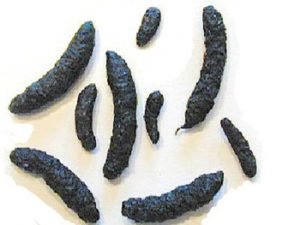
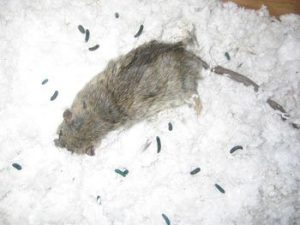
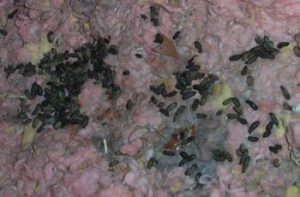
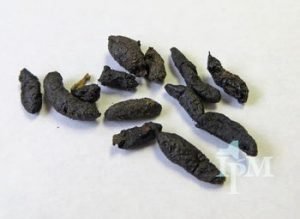
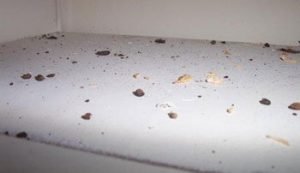
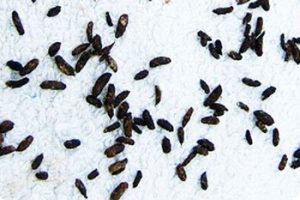
Fresh rat droppings are dark brown or black, moist, and somewhat shiny. As they dry out over the following days, they turn gray, become brittle, and start to crumble when touched. This aging process is actually useful information: if you’re finding fresh, moist droppings, that means rats are still actively using that space, not just passing through at some point in the past.
Shape and size vary by species. Norway rats, the larger and more common of the two rat species found in most homes, produce droppings roughly 3/4 inch long with blunt, rounded ends. Roof rats, which tend to nest higher up in attics and rafters, leave smaller droppings around 1/2 inch long with a distinct curve and pointed ends. Both are noticeably larger than house mouse droppings, which typically run about 1/4 inch and taper to a point on one or both sides.
Rat Poop vs. Mouse Poop: How to Tell the Difference
Size is the fastest way to tell the two apart. Mouse droppings are small enough to be mistaken for grains of rice or dark seeds, while rat droppings are noticeably bulkier and easier to spot even from a few feet away.
Quantity also helps confirm what you’re dealing with. A house mouse produces more droppings per day (50 to 75) than either rat species, despite being the smallest of the three. If you’re finding a large volume of very small droppings, a mouse infestation is more likely than a rat problem, even though rats tend to get more attention.
Location matters too. Roof rats, true to their name, are more likely to leave droppings in attics, on rafters, or along upper walls, while Norway rats tend to stay closer to the ground, in basements, crawl spaces, and near foundations.

Why Rat Droppings Are Dangerous
Rat and mouse droppings can carry several diseases that spread to humans through direct contact, contaminated food, or airborne particles that get kicked up when dry droppings are disturbed. Some of the more serious ones include:
- Hantavirus, which can cause Hantavirus Pulmonary Syndrome, a severe respiratory illness
- Leptospirosis, a bacterial infection spread through contact with contaminated water or surfaces
- Salmonellosis, a foodborne illness that spreads when droppings contaminate stored food
- Rat-bite fever, typically associated with bites or scratches but also linked to contaminated surfaces
- Lymphocytic choriomeningitis (LCM), a viral infection linked to house mouse droppings specifically
Because these risks are real, the CDC recommends specific precautions when cleaning up rodent droppings rather than simply sweeping or vacuuming them away, which can send contaminated dust into the air.
How to Clean Rat Droppings Safely
Cleaning rat droppings the wrong way is actually one of the more common ways people expose themselves to hantavirus, since disturbing dry droppings can release airborne particles. Follow these steps instead of reaching for a broom or vacuum:
- Ventilate the area first. Open windows and doors and leave the space for at least 30 minutes before starting, so any airborne particles have time to clear.
- Wear protective gear. Rubber or latex gloves are essential, and a properly fitted N95 mask adds an extra layer of protection, especially in enclosed spaces like attics or crawl spaces.
- Do not sweep or vacuum dry droppings. This is the single most important rule. Sweeping or vacuuming can aerosolize virus particles, which is exactly how hantavirus most commonly spreads to humans.
- Spray a disinfectant solution first. A bleach solution (about 1 part bleach to 10 parts water) or a commercial disinfectant works well. Spray the droppings and let them soak for at least five minutes before wiping anything up.
- Wipe with paper towels and dispose of them in a sealed bag. Once the droppings are thoroughly soaked, wipe them up and throw the paper towels away immediately in a sealed trash bag.
- Disinfect the surrounding surface. After removing the droppings, wipe down the entire area, including nearby surfaces the droppings may have touched, with the same disinfectant solution.
- Wash your hands thoroughly with soap and water once gloves come off, even if nothing appeared to touch your skin directly.
If you’re dealing with a large volume of droppings, particularly in an enclosed space like an attic, it’s worth considering a professional cleaning service rather than handling it entirely on your own.
Where to Look for Rat Droppings
Rats tend to leave droppings near their nesting and feeding areas rather than scattering them randomly. Check these spots first:
- Along baseboards and in room corners
- Inside cabinets, pantries, and food storage areas
- Attics, crawl spaces, and wall voids
- Behind and underneath large appliances
- Garages, sheds, and basements
Finding droppings in more than one of these areas usually means the infestation has spread beyond a single entry point, which is worth keeping in mind when deciding how aggressively to address it.
What Fresh vs. Old Droppings Tell You
Fresh droppings are dark, moist, and slightly shiny, and they’ll leave a smear if pressed. This means rats are actively using that space right now. Older droppings are dry, gray, and crumble easily when disturbed, which usually points to past activity rather than an ongoing problem in that exact spot.
Checking for fresh droppings a day or two after cleaning an area is a simple way to confirm whether rats are still active there, without needing to guess based on a single observation.
Frequently Asked Questions
Can I get sick just from being near rat droppings?
Yes, in some cases. Hantavirus in particular can spread when dry droppings are disturbed and their particles become airborne, so simply being in an enclosed space with a heavy buildup of old droppings carries some risk, even without direct contact.
How long can rat droppings stay infectious?
Some viruses, including hantavirus, can remain infectious in dried droppings for several days to a few weeks depending on temperature and humidity, which is part of why proper disinfection matters even for droppings that look old.
Is it safe to clean up rat droppings myself?
For a small, contained area, yes, as long as you follow the ventilation, gloves, mask, and disinfectant steps outlined above. For large accumulations, especially in attics or crawl spaces with poor airflow, hiring a professional is the safer choice.
Do rat droppings smell?
A heavy infestation often comes with a musky, ammonia-like odor from accumulated urine rather than the droppings themselves, which is usually the first sign people notice before they spot actual droppings.
What’s the difference between rat droppings and cockroach droppings?
Cockroach droppings are much smaller, resembling coffee grounds or black pepper, and don’t have the tapered or curved shape typical of rodent droppings. If you’re seeing uniformly tiny, gritty specks rather than distinct pellet shapes, it’s worth considering roaches as well as rodents.
Final Thoughts
Identifying rat droppings correctly, and understanding whether you’re dealing with a rat or a mouse, helps you choose the right traps and target the right areas of your home. Just as importantly, cleaning droppings the correct way (ventilating first, avoiding sweeping or vacuuming, and disinfecting properly) protects you from diseases that are far more serious than the cleanup itself might suggest. If an infestation seems widespread or you’re uncomfortable handling it yourself, calling a pest control professional is a reasonable next step rather than something to be embarrassed about.
Rat Dropping Picture Sources
- https://www.flickr.com/photos/99758165@N06/9421750331
- https://www.orlandorats.com/images/damagepoop02.jpg
- https://www.orlandorats.com/images/damagepoop04.jpg
- http://www.aaanimalcontrol.com/Professional-Trapper/gallery/dead012.jpg
- https://i2-prod.mirror.co.uk/incoming/article6158846.ece/ALTERNATES/s615b/Mouse-droppings.jpg



Hello Cheri.
I see that you “swear to keep pests away”?
Personally, I have known a few pests over the years, whose command of four-letter words was vastly better than my own, especially after a few drinks.
So I have learnt I can’t out-swear a pest. Experience shows I can’t out-run them either.
Deperate measures are needed. I did consider poison, but I’ve been told suicide is illegal.
In the end, I moved to a glacier, which is receding faster than the pests can run.
Hi
i live in a beautiful sheltered accomodation flat,which i love.We have communal gardens which are lovely and we often sit out there as some of us have little dogs.
How ever a man who lives here keeps feeding the birds,squirrels and foxes etc,after being told multiple times not to feed the wild life. He has a multiple amount of bird feeders ,even on this windows. Couple of days ago he had scattered our sitting table with seeds. Yesterday i sat near the table the seeds had all gone but there were rat droppings all over the table!!! I will tell our support officer tommorow,he just wont be told im horiffied.
Do i ask her to get the council in??
Thanks for reading
Best regards
Jayne